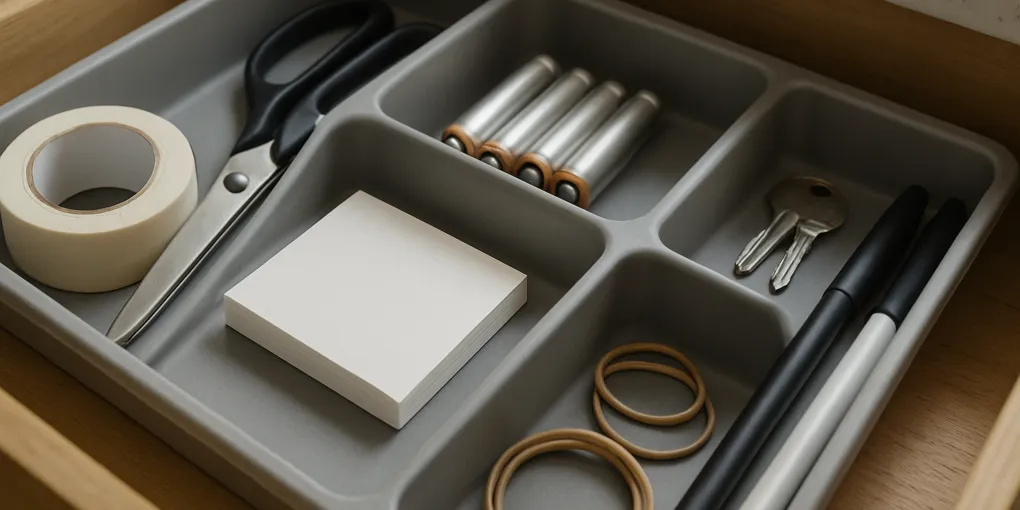
madesmart Junk Drawer Organizer Tray Review: Best for Small Hardware and Batteries?
Reviewmadesmart-style divided junk drawer tray
Best single-drawer resetBest For: Tape, scissors, batteries, pens, labels, and small hardware in one shallow drawer
$10-25
Quick picks
| Product | Key Specs |
|---|---|
| See price on Amazon |
|
| See price on Amazon |
|
| See price on Amazon |
|
Product availability, certifications, and retailer details can change; check the current Amazon page before buying.
A madesmart-style junk drawer organizer tray is most useful when the drawer problem is not volume. It is small-object mixing: tape on top of batteries, scissors buried under pens, loose screws sliding into corners, and one dead flashlight battery that nobody wants to test. The tray can make that drawer usable again, but it is not a magic fix for every household catchall.
The best fit is a shallow utility drawer where the items are short, frequently used, and safe to store in open compartments. If the drawer contains coin batteries, loose blades, medication, matches, or anything a child should not reach, the answer is not only a nicer tray. It is higher storage, a latch, or a separate lidded container. The American Academy of Pediatrics’ childproofing guidance specifically calls out button batteries and small household hazards as items to keep out of children’s reach (HealthyChildren.org).
Quick verdict
Buy a madesmart-style divided tray if your drawer mostly holds small everyday tools and you want one open view when the drawer slides out.
Skip it if the drawer is deep enough for stacked bins, if batteries are the main category, or if children can open the drawer. In those cases, start with a lidded battery case, a child-resistant storage location, or an expandable organizer that matches the drawer width more tightly.
Quick picks
- Best one-drawer reset: a madesmart-style divided junk drawer tray for tape, pens, labels, scissors, and spare keys. Search Amazon for madesmart drawer trays.
- Best wider-drawer alternative: an expandable bamboo utility organizer when the drawer is mostly office tools or kitchen odds and ends. Search Amazon for expandable utility drawer organizers.
- Best safety companion: a lidded battery organizer case with a tester if loose cells are the recurring problem. Search Amazon for battery organizer cases.
What the tray does well
The main advantage is visual separation. A fixed-compartment tray turns one messy layer into small lanes for tools, writing items, tape, adapters, keys, and tiny hardware. That matters because a junk drawer fails when every object has the same status.
A madesmart-style plastic tray also handles ordinary grime better than fabric or unfinished wood. Adhesive residue, pencil dust, and battery packaging scraps are easier to wipe from plastic compartments.
Where it fails
The tray fails when it is asked to hold too many categories. A shallow organizer can separate items, but it cannot make twenty categories easy to maintain. If you need compartments for batteries, stamps, pet tags, hex keys, cabinet bumpers, tape, command strips, spare screws, scissors, markers, charging adapters, and gift cards, the drawer needs fewer jobs.
The second failure is battery storage. Open compartments are convenient, but they do not fully solve battery-contact risk, child access, or dead-cell sorting. The EPA recommends taping or bagging certain used batteries before recycling and keeping used batteries from mixing loosely with other batteries (EPA used household batteries). A tray can hold a small current-use row, but a lidded battery case is the cleaner answer for bulk cells.
The third failure is drawer fit. Many trays look similar online, but a half-inch mismatch can waste a whole side channel or block the drawer from closing over taller tape rolls. Measure the inside box, not the outside drawer face.
Fit checklist before you buy
Measure three things before ordering:
- Interior width from side wall to side wall.
- Interior depth from front inside wall to back inside wall.
- Clearance from drawer bottom to the underside of the counter, shelf, or drawer rail above it.
Then list the tallest items that must stay: a roll of painter’s tape, scissors handles, a small flashlight, a label maker cartridge, or a battery tester. If any item is taller than the tray plus the drawer clearance, it will scrape or force the drawer to stay open.
Also check whether the drawer has a back corner obstruction, center rail, or curved plastic liner. A rigid tray works best in a clean rectangle. If the drawer is odd-shaped, smaller modular bins may fit better than one large insert.
Best use case: utility drawer with adult access
The strongest use case is an adult utility drawer near the kitchen, laundry room, or home office. Put cutting tools in one long lane, tape and adhesive strips in another, writing tools together, and batteries only if they are still in packaging or inside a small case.
That setup pairs well with a closer look at why junk drawers become small hazard zones when your drawer has more than a few cells. The tray handles access; the safety reset handles sorting, tester use, and recycling decisions.
Safety limits for family drawers
Do not treat an open organizer as childproofing. It makes items easier to see, which also makes them easier to grab. Button batteries deserve special attention because they are small, shiny, and dangerous if swallowed. Safe Kids identifies button batteries as a household risk that should be secured away from children (Safe Kids button battery safety).
For family drawers, keep the tray for low-risk items: rubber bands, notepads, spare labels, tape, and capped pens. Move coin cells, medicine, utility blades, super glue, matches, and sharp repair tools to a higher or locked location. If a product needs adult-only access, a neat tray is not enough.
madesmart tray vs expandable bamboo organizer
Choose the madesmart-style plastic tray when the drawer is narrow, shallow, or messy enough that wipe-clean plastic matters. It is usually cheaper and easier to rinse after a marker leak or adhesive mess.
Choose an expandable bamboo organizer when the drawer is wide and you want a more built-in look. Bamboo side wings can fill unused space better than a fixed plastic tray, but battery residue, marker ink, and sticky tape edges are less forgiving on wood.
Choose a lidded battery case when cells are the main problem. It beats an open tray for separating sizes, keeping terminals from casual contact, and making dead-cell cleanup visible.
Two-minute setup protocol
Empty the drawer completely. Throw away dry pens, mystery keys, expired coupons, and broken rubber bands before the tray goes in.
Sort the keepers into five groups: writing, cutting, adhesive, batteries, and hardware. If a group needs more than two compartments, it may deserve its own box outside the drawer.
Place the tray in the drawer empty first. Open and close the drawer a few times. Then load the tallest items and test again. Put the most-used items in the front third, not the center, so the drawer does not need to open fully for tape or scissors.
After one week, remove anything nobody used and anything that drifted into the tray without a clear compartment. A junk drawer organizer works when it narrows choices, not when it politely stores every stray object.
Who should skip it
Skip this tray if your drawer is primarily a battery drawer. Use a lidded battery case instead.
Skip it if you need child-resistant storage. Move hazards, then organize what remains.
Skip it if the drawer is deep enough for two layers of supplies. A shallow tray can waste vertical space when stackable bins or a small parts box would use the depth better.
Skip it if you already have three open catchall trays in the same room. The problem may be too many landing zones, not the wrong tray.
Bottom line
A madesmart-style junk drawer organizer tray is worth buying for a shallow adult utility drawer with small, low-risk items. It is not the right primary storage for coin batteries, loose blades, or anything that needs child-resistant access. Measure the drawer, limit the tray to a few categories, and pair it with a lidded battery case when batteries are more than an occasional item.
Junk Drawer Organizer FAQ
Is the madesmart junk drawer organizer tray enough for batteries?
It can separate a few AA or AAA batteries for adult use, especially if they are still in packaging. For coin cells, bulk batteries, dead batteries, or child-accessible drawers, use a lidded battery organizer case or move the batteries to secured storage.
What should not go in an open junk drawer tray?
Avoid storing medicine, loose button batteries, utility blades, super glue, matches, and sharp repair tools in an open child-accessible tray. Keep the tray for low-risk items such as tape, labels, capped pens, spare keys, and small office supplies.
Is plastic or bamboo better for a junk drawer organizer?
Plastic is better for sticky, dusty, battery-adjacent utility drawers because it wipes clean. Bamboo looks warmer and can fill wide drawers well, but it is less forgiving when markers, adhesives, or battery packaging leave residue.
Frequently Asked Questions
- No. It can separate common AA and AAA cells for adults, but bulk batteries, dead cells, and coin batteries still belong in a lidded or secured battery case.
- Measure interior width, depth, and height, then leave room for fingers to lift tape rolls, scissors, and small tools without scraping the drawer above.
- Choose bamboo when the drawer is wide and mostly holds office or kitchen tools. Choose plastic or a lidded case when batteries, markers, adhesive, or spill-prone items are part of the drawer.